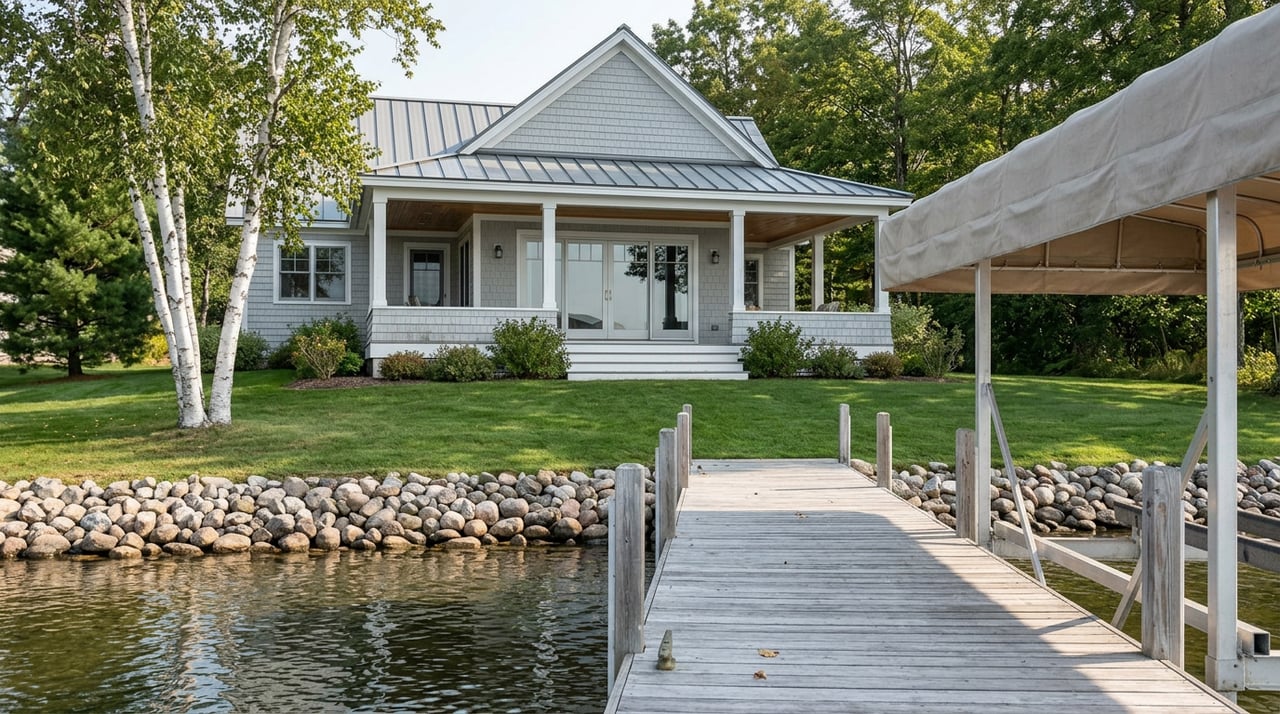
Does a home with no dock, no private beach, and a listing description that never uses the word "waterfront" still need a septic evaluation before it can close?
On Old Mission Peninsula, as of January 1, 2026, the answer for a lot of sellers is yes.
Grand Traverse County adopted a new regulation last year requiring a certified evaluation of a home's well and septic system before any property with a dwelling located within 300 feet of surface water can be sold, transferred, or conveyed. The county's own Time of Transfer page frames this as protection for lakes, rivers, and groundwater, and the commissioners who passed it unanimously in May 2025 were thinking mostly about bay-front cottages with private beaches and boat lifts. That is the obvious reading of a 300-foot buffer.
It is also the wrong way to think about it if you own property on Old Mission.
Why the Buffer Reaches Further Here Than Almost Anywhere Else in the County
Old Mission Peninsula is a narrow finger of land, roughly 18 to 19 miles from base to tip and never more than about three miles wide, with East Grand Traverse Bay on one side and West Grand Traverse Bay on the other. That shape is the whole reason the peninsula built its identity around wine and water views in the first place. It is also the reason a 300-foot rule behaves differently here than it does in, say, Blair Township or Garfield Township, where most residential lots sit nowhere near a lake or stream.
Center Road (M-37) and Peninsula Drive are the only two roads connecting the peninsula to Traverse City, and a large share of the housing along them, from working orchard homes to hillside vineyard properties, sits inside or right at the edge of that 300-foot line even when the home itself doesn't have private frontage. Peninsula Township's own planning documents put more than 70 percent of the township's land in agricultural zoning, much of it laid out in long parcels that run from the road down toward the bay. A property can carry a vineyard view, a shared driveway, and a listing that never mentions the word "waterfront," and still fall inside the buffer once someone measures from the closest wall of the house to the water's edge.
The county's regulation also defines what counts as surface water more broadly than most sellers expect. It isn't limited to the bay. Streams and wetlands that hold water for at least six months out of the year qualify too, according to the county's draft regulation. A farm parcel with a drainage creek running through the back forty can trigger the same requirement as a cottage on the beach.
When the ordinance was still in draft form, county officials estimated it would affect somewhere between 200 and 400 property transfers a year across all of Grand Traverse County, according to reporting from the Traverse Ticker. Old Mission accounts for a small fraction of the county's total land area but an outsized share of its shoreline, given that it's bounded by two bays instead of one. That math points to the same conclusion the geography does: the peninsula is likely carrying more than its proportional weight of these transfers.
What the Evaluation Actually Covers, and What It Costs
The evaluation itself is not a quick paperwork exercise. A certified inspector checks the septic tank's condition, examines the drain field for signs of ponding or failure, and verifies that the well meets required separation distances from the septic system. The Grand Traverse County Health Department has told local reporters that a full inspection typically runs $400 to $750, depending on the property and the amount of digging required to access buried components. The county also noted that roughly 25,000 residences countywide rely on septic systems, with an average system age of 28 years, so a fair number of sellers will be evaluating a system that has never been inspected on record.
A passed evaluation is good for 36 months. If a system was certified within that window before the sale, a new inspection generally isn't required. If it fails, the county's regulation calls for a corrective action plan to be approved before closing, which usually means either repairing the system or negotiating an escrow arrangement so the work can happen after the sale. Statewide guidance on Michigan septic transactions notes that buyers financing through FHA or VA loans will typically need separate lender documentation on top of whatever the county requires, so a passed county evaluation doesn't automatically satisfy every loan type.
Old Mission's Rule Is Actually the Gentler One
Sellers who have shopped both Old Mission and Leelanau Peninsula sometimes assume the two markets carry the same transfer requirements, since both sit along the same stretch of Grand Traverse Bay water and both lean heavily on well and septic systems. They don't.
| Grand Traverse County (Old Mission) | Leelanau & Benzie Counties | |
|---|---|---|
| Effective date | January 1, 2026 | Leelanau since January 2023, Benzie since 1992 |
| Distance trigger | Within 300 feet of surface water | No distance buffer, applies countywide |
| What's covered | Homes near lakes, streams, and qualifying wetlands | Every private well or septic system, lakefront or 40 acres inland |
| Evaluation validity | 36 months | Similar multi-year window, but water quality tests expire faster |
Grand Traverse County chose a targeted rollout, starting with properties nearest the water and leaving room to expand later. The Benzie-Leelanau District Health Department never built in a buffer at all. Every conveyance with a private well or septic system in those two counties requires evaluation, whether the parcel touches Lake Leelanau or sits on a hunting property miles from any lake. For a peninsula that reads as "surrounded by water," Old Mission's rule is the more forgiving one on paper. In practice, the shape of the land closes most of that gap.
What to Do Before You List
- Check the parcel, not the listing description. The county's ArcGIS Tax Parcel Map Viewer includes a Time of Transfer layer that shows whether a specific parcel falls inside the 300-foot line. Don't assume based on whether the MLS sheet says "water view" or "waterfront."
- Ask when the system was last certified. If a prior evaluation exists and it's less than 36 months old, you may not need a new one.
- Confirm your inspector is on the county's certified roster. A pump-and-inspect from a general septic contractor won't satisfy the ordinance unless that contractor is certified through the Grand Traverse County Health Department.
- Build the timeline into your listing plan. With a limited pool of certified evaluators covering a county that estimates hundreds of transfers a year could qualify, scheduling ahead matters more than it did before January 2026.
- Budget for the possibility of a failed system. Grand Traverse County has noted that a meaningful share of septic replacements countywide happen because a system failed rather than aged out on schedule, so a proactive inspection before listing can prevent a surprise mid-contract.
Only a minority of Michigan counties have gone this route. A recent estimate from the Michigan Waterfront Alliance put the share of Michigan counties with any point-of-sale septic requirement at around 13 percent. Grand Traverse joining that list changes the closing math for a peninsula where a large share of the housing stock was never required to prove its septic system worked at all until now.
A Few Direct Questions
My home is across Center Road from the bay, not directly on it. Does the rule still apply? It depends on the distance from the closest point of your dwelling to the water, not on whether your lot has private frontage. A home across the road can still fall inside 300 feet depending on lot depth and road placement. Check the parcel viewer rather than guessing from the listing category.
What if my septic system was inspected two years ago for a different reason, like an addition permit? If that inspection meets the county's evaluation standard and falls within the 36-month window before your closing date, it may satisfy the requirement. Confirm with the Health Department's Environmental Health Division before you assume you're covered.
Does this apply to land contracts or transfers between family members, not just a traditional MLS sale? The county's regulation uses the broader language of sale, transfer, or conveyance. If you're handling anything other than a standard arm's-length sale, it's worth a direct call to Grand Traverse County Environmental Health to confirm how your specific transaction is classified.
Listings on Old Mission span a wide range, from inland condos priced in the $270,000s to $330,000s to waterfront and vineyard-adjacent estates between $1 million and $3 million, with select trophy properties exceeding $5 million, based on market tracking from late 2025 into early 2026. On a market with that much value riding on each closing, a septic timeline that catches sellers off guard is the kind of friction worth planning around months in advance rather than discovering during escrow.
If you're weighing a sale on Old Mission Peninsula and want a straight read on how this rule applies to your specific parcel, Michael Annelin has spent his career in these townships and can walk the timeline with you before you ever put a sign in the yard. Let's Connect.