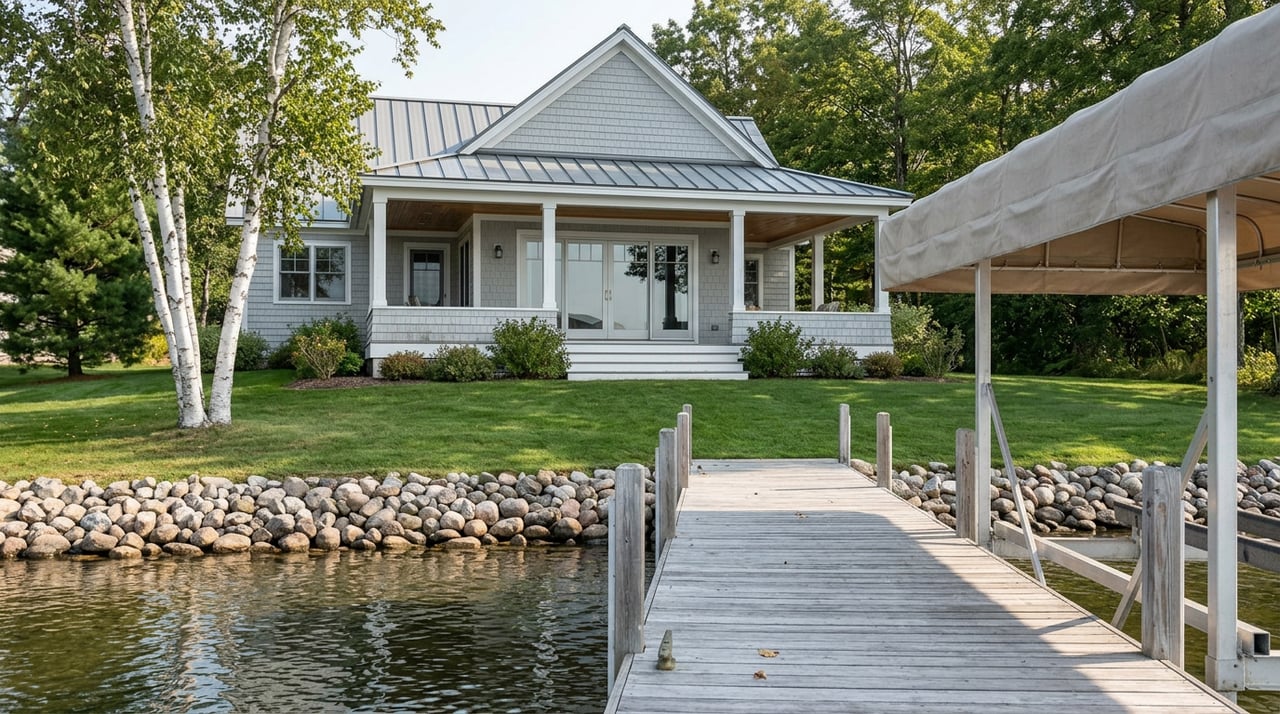
Most buyers assume that when a listing says "100 feet of Lake Leelanau frontage," the dock sitting at the end of that frontage comes with it. In Michigan, that assumption is only half right. The rights that let you use the water transfer automatically with the deed. The dock itself, and your legal standing to keep it exactly where it sits, is a separate question, and on a lake shaped like Lake Leelanau, it is a question that trips up more closings than buyers expect.
Riparian Rights Travel With the Land. The Dock Doesn't Always Follow.
Michigan law is clear on one point: riparian rights attach to the property, not to the person who happens to hold title at a given moment. When you buy a parcel that touches Lake Leelanau, you automatically inherit the bundle of rights that comes with it, including reasonable access to the water and the right to place a dock on your own bottomland. You don't need a special clause in the purchase agreement for that to happen. It happens because you own the land.
What doesn't happen automatically is verification that the physical dock in the water is legally where it's supposed to be, that it's permitted if a permit is required, or that it belongs entirely to the parcel you're buying rather than to a shared arrangement with the neighbors. Those are three separate facts, and a title company checking for liens has no reason to chase down any of them.
Seasonal or Permanent Changes Everything
The Michigan Department of Environment, Great Lakes, and Energy draws a hard line between two categories of dock, and which side of that line a structure falls on determines whether it needed a state permit in the first place.
| Dock Type | Permit Required? | Condition |
|---|---|---|
| Seasonal dock or boat hoist | No | Removed at the end of the boating season, used privately and non-commercially, doesn't unreasonably interfere with others' use of the water |
| Permanent dock or boat hoist | Yes | Left in the water year-round, requires a permit under Part 301 of the Natural Resources and Environmental Protection Act |
A dock that gets pulled every fall and reset every spring, which is the norm on most of Lake Leelanau's residential frontage, never needed a permit and never triggers this issue. The problem shows up when a structure has quietly become permanent. Maybe it was left in over a mild winter a few years back and nobody pulled it the next spring either. Maybe a previous owner poured concrete footings to stop the seasonal shuffling. Once a dock stops coming out every year, it crosses into the category that requires a Part 301 permit from EGLE, and if that permit was never applied for, the structure has been out of compliance the entire time, regardless of how long it's been sitting there. Buying the property doesn't reset that clock. The new owner inherits the same unpermitted dock.
Why Lake Leelanau's Shape Makes the Boundary Question Harder Than It Looks
Even when a dock's permit status is clean, there's a second layer buyers rarely think to check: whether the dock actually sits on the bottomland that belongs to the parcel being sold.
Michigan determines underwater lot lines using what's called the thread line method, extending each riparian owner's boundary out to a center line running down the lake. On a roughly circular lake, that's a straightforward exercise. Lake Leelanau isn't circular. It runs about 21 miles from end to end, is less than two miles wide at its widest point, and is split into two distinct basins connected by a narrows near the village of Lake Leelanau, with the whole system eventually draining out through the Leland River to Lake Michigan. That elongated, two-basin shape means the angle at which any single parcel's underwater boundary should radiate toward the center line is genuinely harder to eyeball than it would be on a round kettle lake, and Michigan's own lake law guidance acknowledges that these underwater angles rarely line up neatly with the property's side lot lines on dry land. A dock installed by feel, rather than by survey, on a bay or narrows section of Lake Leelanau has a real chance of drifting onto a neighbor's bottomland without anyone realizing it for years.
The Shared Dock Surprise
There's a third wrinkle specific to Lake Leelanau's mix of housing stock. Not every waterfront property here has a private dock. A meaningful share of homes, particularly on the more built-up stretches near Lake Leelanau village and Provemont, use shared or association-owned docks instead. That arrangement isn't a problem on its own. It becomes a problem when a buyer assumes exclusive ownership of a structure that's actually subject to a slip assignment, a shared maintenance agreement, or use limits set by a lake association, and finds this out after closing rather than before writing the offer.
None of this is theoretical for the current market. A ranch on South Lake Leelanau with 100 feet of private, sandy-bottom frontage closed in August 2026 for $1.425 million, and waterfront inventory on this lake tends to move quickly once it's priced right. That pace is exactly why dock and boundary due diligence gets skipped. Buyers competing for a limited number of Lake Leelanau listings don't want to slow down an offer to chase down permit records, so they don't, and the question only resurfaces if a neighbor raises it or the next sale requires a fresh survey.
What to Check Before You Write the Offer
A buyer or seller can resolve almost all of this before it becomes a problem, using steps that take days, not weeks.
- Ask the seller directly whether the dock is seasonal or permanent, and whether it's ever been left in over a winter.
- If it's permanent, request the EGLE Part 301 permit number and confirm it matches what's currently in the water.
- Order a current survey tied to the ordinary high-water mark that shows the underwater boundary line, not just the dry-land lot lines.
- Ask whether the dock is private or shared, and if shared, request any recorded maintenance agreement or slip assignment.
- Check the Leelanau County Register of Deeds for easements, covenants, or riparian language attached to the parcel.
For sellers, running this checklist before listing does more than avoid a headache. A dock with a clean permit history, a boundary that matches the survey, and clear private ownership is a selling point that can be stated plainly in the listing rather than left for a buyer's agent to uncover during inspection.
A Few Direct Questions
Do riparian rights transfer automatically when I buy waterfront property on Lake Leelanau? Yes. Riparian rights are attached to the land itself under Michigan law and cannot be sold or held separately from the parcel. When you close on the property, you receive those rights along with the deed.
If a dock was never permitted, is that the new owner's problem or the seller's? The obligation to bring an out-of-compliance permanent dock into line with Part 301 runs with the property, not with whoever built it. A buyer who closes on a home with an unpermitted permanent dock takes on that compliance question, which is exactly why it's worth resolving before the offer rather than after the deed records.
Are shared docks common on Lake Leelanau specifically? They show up often enough on the lake's more developed stretches that buyers shouldn't assume a dock is private just because it's listed as part of the property. Confirming ownership in writing before closing avoids a dispute later.
If you're weighing a Lake Leelanau property, or any inland lake listing on the Leelanau Peninsula, this is exactly the kind of detail worth sorting out before you get emotionally attached to a dock that might not be entirely yours to keep. Mike Annelin has walked Leelanau County waterfront buyers and sellers through this exact conversation more than once, and would rather answer the dock question on the front end than have it surface at inspection. Let's Connect before you write the offer.